
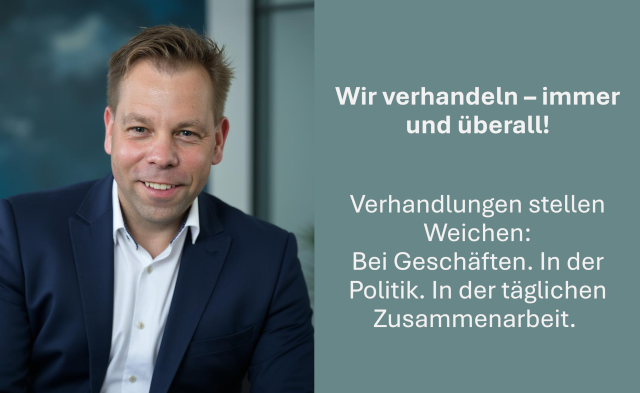

An interview with Volker Kleinert. Volker is a lecturer and trainer on the topic of "negotiation skills". At the same time, he brings unique experience from 19 years of police service, where he was, among other things, the first point of contact for hostage, suicide and threat situations, as well as a tactical security spokesperson.
„In your experience, Volker, what is the most common negotiating mistake that almost everyone makes – even experienced people?“
„"Rely on arguments – arguments are serial killers, as the saying goes. Especially in negotiations between two parties, there's ultimately no third party, like a court, deciding. So it's more advantageous for someone to convince themselves rather than being convinced by others. Good arguments are helpful, but I can also present them as questions and give the other party space, making it easier for them to agree or change their position."“
„"If you only had one sentence to turn a negotiation around, what would it be?"“
„“"How is that supposed to work?“This opens up new possibilities and gives me time to think.“
„"What three signals will tell you in the first 60 seconds whether a negotiation will be difficult?"“
„"First, a demand that can only be answered with yes or no. Second, the absence of a common goal, and third, when someone only discusses their own position and only seeks their own advantage. Then it's sometimes worth withdrawing quickly, because, as John F. Kennedy once so aptly put it: „"We cannot negotiate with those who say, 'What's mine is mine, and what's yours is a matter for negotiation.'"““
„What do many people do when they hear „no“ – and what would be better?“
„"They choose the phrase 'Yes, but...'. It would be better to use calibrating questions to find out the reason behind the 'no'. Professionals often initially get the other party to say no to create an illusion of control. Those who have already said no feel better. Ultimately, of course, the goal is agreement."„
„"How do you deal with silence at the table?"“
„"Endure it. And often, remain silent yourself. In training sessions, we even actively practice silence. For many people, this is uncomfortable. It then becomes a question of self-management. And unfortunately, this is very often not practiced at all. Why, I find inexplicable. Sadly, there's a blind spot here. I know so many people who have prepared perfectly and fail in negotiations due to a lack of self-management, for example, when the other party remains silent. If the other party, for instance, names a price or makes a high demand, silence is often very effective."“
„"How do you react when the other person says 'This is our final price'?"„
„"By asking the counter-question, 'And you want to let it fail because of the price?' – it often becomes clear whether that's really the case or whether we still have room for negotiation. After that, I can still decide whether I want to accept it or not."„
„"What is the best way to deal with time pressure ('We have to decide today')?"„
„"Take a deep breath. Those who are well-prepared can often make quick decisions. That's why preparation is so important, so that time pressure doesn't become a problem. If an offer suits me, I can decide quickly. However, I will have already invested time. Anyone who "has to" negotiate under time pressure should be well-trained in negotiation skills and self-management. Forward-thinking negotiators avoid time pressure as much as possible by negotiating the process itself."„
„"Concrete mini-tools: What is your standard structure for a negotiation in 5 steps?"“
„"I consider what my target area is, what words I want to use to start, what my interests are, what the other party's interests are, and what alternatives I have. And then we negotiate with each other."“
„"What question is almost always asked to elicit interests rather than positions?"“
„"With 'Why?' – what does the person want this for? This requires the ability to listen. It's one of the most underestimated skills. Almost always, people only focus on what they want to say. And at the same time, we miss the opportunity to understand the other person, to truly listen. This is where so much falls apart: relationships, business deals, partnerships, etc. – because we haven't understood each other, and understanding doesn't necessarily mean agreeing."„
„"How do you formulate a counter-offer without damaging the relationship?"“
„"A standard approach might be to say something like: 'Given your offer, it seems we see things completely differently. For me, the following is realistic: ...! How about we try to close the gap together?'"„
„"What two sentences help when someone becomes unreasonable or aggressive?"“
„"What do you hope to achieve with this?" and "How do you believe your behavior will affect the further course of the negotiations?" – My goal is to make the other party think, because thinking people cannot be aggressive, and unfortunately, vice versa. Of course, we should also pay attention to our tone of voice."“
„"Tell me about a negotiation that almost went wrong – and what saved it.".
„"There are many. Especially in situations where many people think it's not a negotiation. In my relationship, there have been and will continue to be emotionally charged situations. What has often saved me is asking about the goal and focusing on interests. And sometimes, breaking out of the negative spiral with the words, 'Even though we disagree right now, I really care about you!'"„
I think everyone knows situations that start innocently enough, like this opening line: "You've left the socks in the living room again. It seems like my well-being is never important to you. My friends all say that people who never care about their partners' needs are pure egoists!" Inwardly, I felt attacked and had a strong urge to strike back, for example, with the words, "You only ever think about yourself." I had indeed left the socks, but does that automatically make me an egoist? In this case, questions like, "What makes you think I'm an egoist because of that? Couldn't it be that I'm just forgetful?" are helpful.„
„"What was your toughest negotiation – and what did you learn from it?"“
„"That was with a superior, when it came to my career development, which he didn't want, and my interests played absolutely no role. I knew I was right and that my position would be better for the organization, but in the hierarchy, I was simply below him and therefore had no chance. What I learned from that is that you should sometimes ask yourself whether you want to be right or happy. In such situations, it's sometimes good to remain silent and focus on alternatives. While I can't achieve my goals in every negotiation, I only have a problem when I no longer have any alternatives – you have to create them. Often at a price. And unfortunately, I also learned the bitter truth that being right and getting justice are two different things."“
„"Do you have an example where being 'too nice' became expensive: What happened?"„
„"Almost always it's due to a lack of preparation or unfavorable circumstances. And 'too expensive' is relative, too. What does that actually mean? Many people negotiate incredibly hard on small things, like classified ads, haggling endlessly. But when it comes to important matters, we're too nice or don't negotiate at all.".
We then negotiate with ourselves, telling ourselves, "It's a very difficult situation for our company, so I'd better not ask for a raise." The most expensive negotiations are often the ones we don't make out of politeness. I think everyone can relate to this: we don't ask for help because we don't want to be a burden. Yet there are people who would gladly help, and we deny them the opportunity. It would be good for our society if we cooperated with each other more again. In many areas.„
„Many believe: „Those who negotiate hard destroy relationships.“ Is that true, Volker?“
It depends. Those who adhere to the Harvard principle – "tough on the issue, soft on the people" – strengthen relationships. However, those who only want their own maximum gain and concede nothing to the other party destroy relationships. We are increasingly observing this in politics, business, and society. Unfortunately. The dilemma lies in the fact that one can increase one's short-term gain at the expense of others, but we forget the medium- to long-term consequences. Through cooperative approaches, we can create value for both sides, and that then also gives us greater security.„
„"Is negotiation more a matter of talent or skill? Why?"“
„"A mixture of both. There are talented people who are naturally good at negotiating or who 'learned' as children to ask smart questions, to consider how to assert themselves and also to set boundaries. Nevertheless, it is also a craft. Good preparation, for example, is one of the craft skills."„
As in sports, talent is great. But often hard work beats talent, and at the same time, professionals combine talent, hard work, and skill. It takes training with thoughtful exercises.“
What is the difference between "confident" and "dominant" in negotiations?
„"Self-confident people can assess their abilities and opportunities in relation to the current situation, sometimes hold back, and recognize when there is no opportunity or time for negotiation.".
Dominant people simply exert pressure and wield their power. Whether this constitutes "negotiation" or merely a "power play" is a question I'd like to raise. It's similar to companies, where one should critically examine whether they're conducting goal-setting meetings or goal-dictation meetings. With goal-dictation, market changes and the employees' expertise are simply ignored.
A negotiation is therefore often simply a good conversation where opinions can become insights. Self-confident people are more likely to change their positions, while dominant people are not.“
„"What distinguishes negotiations between internal (stakeholders) and external (customers/suppliers)?"“
„"Nothing. The same principles apply. People often think there are differences between internal and external negotiation, or between industries. However, it's always about aligning goals, uniting interests, building relationships, and keeping alternatives open."“
„"How do you negotiate salary or resources with your boss?"“
We are well advised to draw comparisons: what is customary, what value we achieve, what is important to me, and what interests the company also has. For this, one should seek out reputable sources. Ideally, a manager should also proactively consider whether they are paying their employees well and actively seek negotiations with them.
Personally, I find it problematic when we talk about "personnel costs." I think the term "personnel investment" is much more appropriate, because employees should also be "value-added," meaning they create value at a price that is worthwhile. And they also receive value from the company, namely reduced income insecurity and risk. Especially in today's world, negotiations are therefore becoming more important: How do we agree on workplaces (e.g., home office), working hours, compensation, and also strategic directions? And we should always keep that in mind.„
„"What role do data vs. impact play – and how do you balance that?"“
„"Ideally, the question should be: What impact do I want to achieve with my data? The way the data is presented is crucial to its impact. For example, are we talking about 1.5 degrees of global warming, or are we showing, for instance, how regions are changing? Depending on the audience, this can be presented differently. Think of Steve Jobs' product presentations. When he introduced the first iPod, for example, he didn't mention the product's specifications, but instead said, '1000 songs in your pocket.' Today's youth would probably be unmoved by that, since they have access to far more through streaming. Back then—when most people still used a Walkman or Discman—it was fantastic: Everyone immediately had a mental image of how you could fit about 50 CDs in your pocket. The specifications, such as storage capacity, etc., aren't so important. The product's benefit to me, however, is all the more crucial. Good negotiators, therefore, pay attention to the desired impact of their data." A great example of how to present data with a focus on impact are the TED Talks by Hans Rosling.„
„"How can you recognize a 'good' agreement – apart from the price?"„
„"We can look each other in the eye afterwards and neither of us has the feeling of having lost or absolutely won.".
„"Which two skills do you think improve results the fastest?"“
The focus on interests and the will to create value together.
„"What typically changes in practice after good negotiation training?"“
„"We realize that 'winning' isn't actually the best or the only goal. We become calmer in negotiations, value relationships, and balance interests. We create more value. For companies, this usually translates into significant financial gain. Not just in trade or foreign relations. We improve collaboration, reduce absenteeism, enhance working conditions, boost innovation, learn from mistakes, and much more. Negotiations are ubiquitous and immensely valuable."„
„"For whom are your seminars particularly useful – and for whom are they less so?"“
„"From my perspective, it's beneficial for everyone, although one could argue that as a trainer and lecturer in negotiation skills, I'm naturally passionate about the topic. However, someone who lives in isolation, has no contact with the outside world, is single and intends to remain so, doesn't own pets, only orders easily comparable goods online, doesn't use services, and doesn't make phone calls, wouldn't benefit from it. Everyone else would."“
„"What is your biggest negotiating annoyance: price-cutters, tactical games, or radio silence?"“
„Price-cutters who compare apples and oranges and at the same time refuse to give the other party any room.“
„"Is it better to counter immediately or to summarize and reflect first?"“
„"Summarize with a focus on agreement, to ensure everyone has understood everything correctly. Then we can work together to find solutions."“
„"Which situation is more stressful: salary, customer, supplier or internal conflict?"“
„"It depends on the extent and the alternatives. Each one of them can be really bad and at the same time not a problem if I have worthwhile alternatives. If the customer is stressful and I have alternative customers, I can switch customers. If the salary is a problem and I have alternative offers, I don't have a problem."“
Thank you, Volker, for your valuable and exciting insight into the topic of "negotiations".